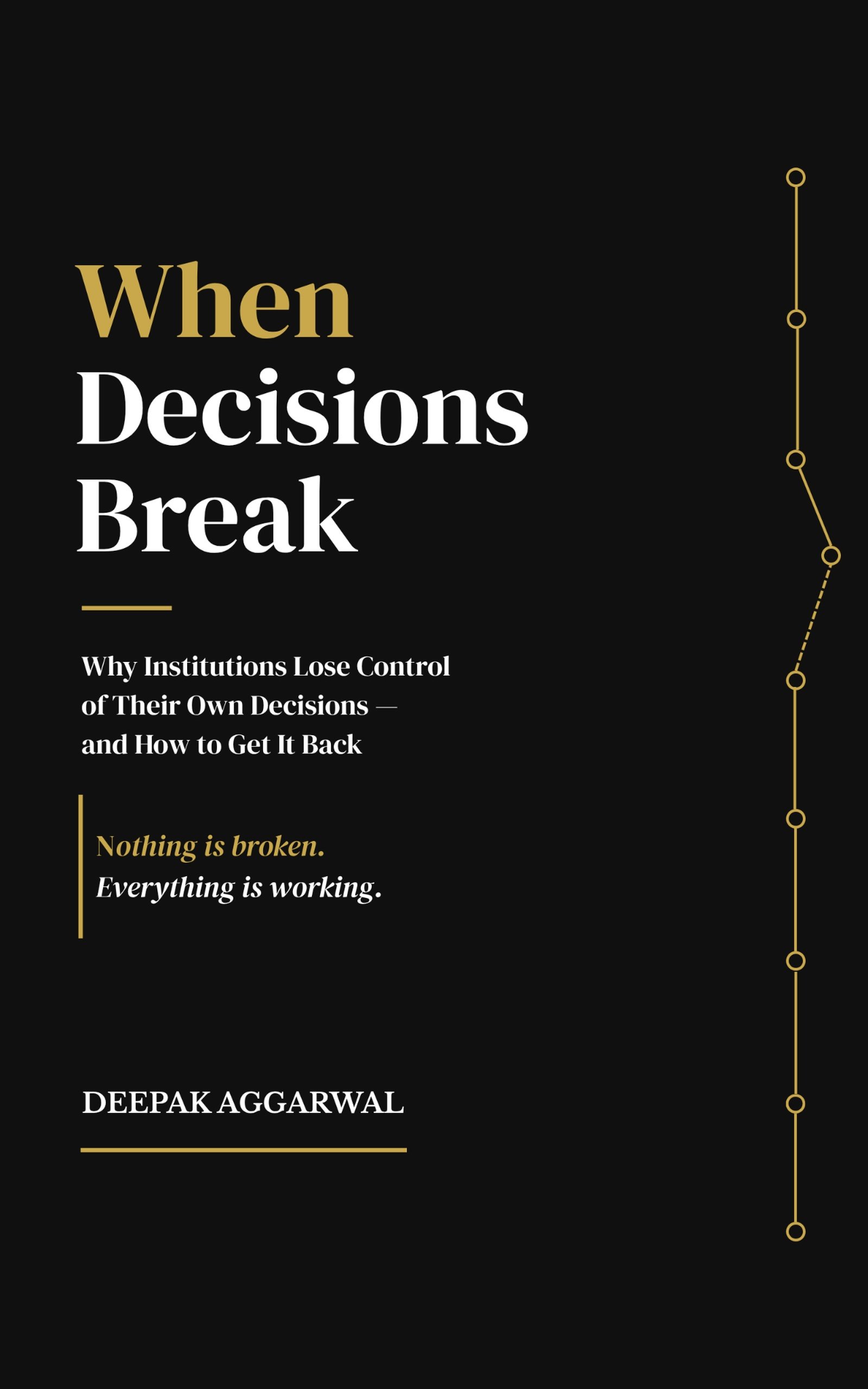
Governance told you who decides.
Nobody engineered what deciding actually means.

Most institutions cannot replay
their own decisions.
The consequence surfaces 18–36 months after the chain broke.

While dashboards stay green, Decision Drift accumulates silently — in the gap between what the board authorised and what the institution actually executed. 60–80% of loss in major failures was not the original error. It was the inability to stop what followed.

Ten days. Eight layers. One board-ready finding.

Start the Decision Drift Audit → Read real failures →
25+ years · FSI · Healthcare · Financial market infrastructure | eJournals: Fed NY · NYU Stern · UCL · BIS · IMF · LSE · Harvard · Georgetown Law
SSRN · Top 10% of 2.73M authors · 8 papers | 25+ jurisdictions · Americas · Europe · MEA · Asia-Pacific | See all work →

// What happens when institutions cannot replay decisions

Five consequences.
All of them invisible until they are not.

01
Customers receive inconsistent outcomes

The same operational logic. Divergent outcomes. No one internally can trace why. Outside investigators can.

02
Risk accumulates invisibly

Each individual action remains within bounded thresholds. The aggregate system state drifts into danger. SVB. The Gilt Crisis. The pattern is the same.

03
Boards lose causal visibility

The dashboards are green. The board is satisfied. The consequence arrives four months later, unreconstructable.

04
AI scales misalignment

Execution that drifted at human speed now drifts at machine speed. Volume compounds what governance missed.

05
Accountability dissolves across layers

Everyone followed their process. Nobody owned the outcome. The regulator disagrees with that framing.

// Institutional drift path — how it compounds

BOARD INTENT L1 · Purpose intact Governance covers this encoded STRATEGY L2–L3 · Assumed Rarely verified gap opens ↓ EXECUTION L4–L5 · Rules drift No replay possible no stop OUTCOME L6–L7 · Unowned Loss locks here CONSEQUENCE Regulator. Board. Loss event. — 60–80% of total loss was amplification, not the original error. ▲ GOVERNANCE FRAMEWORKS COVER THIS ZONE ▼ DRIFT AND LOSS LIVE IN THIS ZONE

This is not a governance failure. It is an architecture failure. The decisions happened. The chain was never built to hold them.

Start the Drift Audit →

// The question to ask tomorrow morning

"Which decision made in this institution in the last 90 days could your team not fully replay today?"

Who authorised it. Which rules fired. What data was used.

"If the regulator asked for a decision trail from 18 months ago — how long would reconstruction take?"

SVB's answer was four months. By then it no longer mattered.

"When your AI model made 10,000 decisions last month — what was the boundary of its authority?"

If the answer is not in writing, it was not a boundary. It was an assumption.

If your governance committee cannot produce written answers to these questions — the audit has already begun. Start it deliberately →

// Three ways to engage — start wherever the problem is clearest

10 days · The Audit

Decision Drift Audit

Eight layers mapped. Every gap between board intent and execution identified. Board-ready finding in 10 days.

Start the audit →
Half day · The Session

Governance Interrogation

Structured working session with your board or ExCo. Three questions. Your institution's real cases. Written follow-up in 48 hours.

Enquire →
Monthly · The Retainer

Decision Architect Retainer

An independent practitioner embedded in your governance cycle. Board papers reviewed. Architecture designed. On-call advisory.

Enquire →

All engagements are confidential from the first exchange. An NDA can be executed before any substantive discussion. · Full engagement details →

// 01 · Diagnosis — what the data shows

Three failures. Three boards that did not see it coming.
One structural finding across all of them.

SVB · March 2023
4 months

To reconstruct the decision timeline after collapse. The data existed. The chain did not.

DIC™ L6 — no replay infrastructure
Knight Capital · August 2012
$440m · 45 min

Intent at deployment did not match rules at execution. Every agent complied. The institution did not survive the gap.

DIC™ L3–L4 decoupling
UK Gilt Crisis · September 2022
£65bn

Every LDI fund was individually compliant. No single decision wrong. No feedback loop at network scale.

DIC™ L8 — no cross-institutional feedback
The structural finding — across all cases
60–80%

Of total loss was amplification — not the original error. The error was recoverable. The inability to intervene in time was not.

This is the governance gap Decision Engineering™ closes.
See six real decision failures mapped through the DIC™ →

// 02 · Prescription — what needs to be intact

Eight layers. Break any one.
Outcomes drift.

Most governance frameworks cover L1–L3. The failures above happened in L4–L8. That gap has a name.

// Decision Integrity Chain™ — all eight layers

DECISION INTEGRITY CHAIN™ L1 PURPOSE Why exist? Coutts · NHS L2 STRATEGY Encoded? Credit Suisse L3 INTENT Authorised? Wells Fargo GOVERNANCE FRAMEWORKS COVER THIS ZONE GAP L4 RULES Approved? Knight Capital L5 JUDGMENT Who owns? Goldman · UHG L6 DECISION Replayable? SVB L7 OUTCOME Owned? UK Gilts L8 FEEDBACK Reality? UK Gilts DRIFT AND LOSS LIVE IN THIS ZONE L8 feedback loop — the chain is only intact when L8 closes back to L1 Replayability — not explainability — is the true governance standard
L1
Purpose
Why does this institution exist — and does every decision reflect it?
Coutts · NHS Triage
Issue 001 →
L2
Strategy
Is strategic intent encoded where decisions actually happen?
Credit Suisse · NHS England
Issue 002 →
L3
Intent
Does every automated decision know why it is authorised?
Wells Fargo · Kaiser Permanente
Issue 003 →
L4
Rules
Are the rules running what the board approved? Knight Capital failed here.
Wirecard AG · Orpea Group
Issue 004 →
L5
Judgment
Who owns the decision when the model makes the call?
L6
Decision
Can this decision be replayed end-to-end as it actually happened? SVB failed here.
L7
Outcome
Who owns an outcome that nobody explicitly decided?
L8
Feedback
Does the system learn from what happened — or from what was reported? UK Gilts failed here.
See the work behind the framework → See the three-year governance roadmap →

// 03 · Treatment — how Decision Engineering™ helps

Three engagements.
Not a report. A finding.

A structured interrogation of the decision chain — delivered as something a board can act on, not archive.

This is not an indictment of your existing teams. It is a mathematical validation framework — one that equips your CRO, CIO, and Board to see precisely where rules and execution have diverged, and why.

// Replay-Ready Infrastructure — what the audit produces

FUSE™ Capture Every decision recorded at point of execution STAGE™ Structure Mapped to all 8 DIC™ layers DIC™+L8 Verify Chain integrity confirmed. Gaps named. REPLAY-READY INFRASTRUCTURE Any decision. Any point in time. Who authorised · Rules that fired Data used · Where it could have stopped Replay-Ready Infrastructure (RRI) — the DIC ChainTrace™ output delivered by the Decision Drift Audit
01 · 10 days

The Decision Drift Audit

All eight DIC™ layers mapped. Every gap between board intent and operational execution identified. Replay capability assessed. Board-ready findings in 10 days.

All 8 DIC™ layers mapped
Replay capability assessed
Board-ready finding delivered
Start the audit →
02 · Half day

The Governance Interrogation

A structured working session with your board or ExCo. Three questions. Three layers. Real cases from your institution. Written follow-up within 48 hours.

Board or ExCo level
Your institution's real cases
Written follow-up in 48 hours
Enquire →
03 · Monthly

The Decision Architect Retainer

An independent practitioner embedded in your governance cycle — not your politics. Board papers reviewed. Decision architecture designed. Governance questions answered as they arise.

Monthly retainer
Board paper review
On-call governance advisory
Enquire →

"If you cannot replay a decision, you should not automate it."

— The Irrecoverable Institution · Aggarwal (2026) · SSRN abstract_id=6714238

Start the conversation →

// The work behind the framework

25+
Years · FSI · Healthcare
Financial market infrastructure
25+
Jurisdictions
Americas · Europe · MEA · Asia-Pacific
8
SSRN papers · Top 10%
2.73M authors · 6 months
10
Institutions examined
Public record · Primary sources

// Institutions examined — all cited from public record, regulatory findings, and primary sources

SVB Knight Capital Credit Suisse Wirecard AG Wells Fargo Coutts Orpea Group Kaiser Permanente Goldman Sachs / Apple Card UnitedHealth / nH Predict UK LDI Funds · £65bn NHS England

// Published — SSRN · Author ID 9450612

Reimagining the Future of Banking in a Protocol-Driven World
SSRN · abstract_id=5878263
The Irrecoverable Institution — Why Replayability, Not Explainability, Is the Governance Standard
SSRN · abstract_id=6714238
When the Protocol Decides — Replay-Ready Infrastructure for Programmable Financial Institutions
SSRN · abstract_id=6746520
Agentic Retail Banking · Network-Scale Governance Failure · Decision Integrity Chain™ series
SSRN · 5 additional papers · practitioner governance lens
Read all eight papers →

// Regulatory and policy context

MAS / Singapore — AI governance frameworks, model risk management, FEAT principles
EU AI Act / EBA — high-risk AI classification, explainability obligations, audit trail requirements
Basel / BCBS — operational resilience, RDARR data integrity, third-party AI risk
OCC · Fed · NY DFS — model governance SR 11-7, fair lending in automated decisioning, consent order precedents
Read the institutional failure cases →
Read the work → See the governance roadmap →

Decision Engineering™ Newsletter

One DIC™ layer per issue. One institutional failure. Free on Substack. For boards and practitioners who suspect the dashboards are not telling the whole story.

Subscribe free →

// Disclaimer & Legal Notices

The views, analyses, and perspectives expressed on this site are solely those of Deepak Aggarwal, presented in a personal and independent capacity. They do not represent or reflect the views, policies, or positions of any current or past employer, client, organisation, or affiliated entity.

All institutional case references — including but not limited to SVB, Knight Capital Group, Wirecard AG, Credit Suisse, Wells Fargo, Coutts, Orpea Group, Kaiser Permanente, and NHS entities — are cited solely on the basis of publicly documented regulatory findings, official investigations, court records, parliamentary reports, and other published primary sources. No non-public information has been used. All analysis is independent, educational, and analytical in nature.

Nothing on this site constitutes legal, regulatory, financial, investment, or professional advice of any kind. The Decision Integrity Chain™, Decision Engineering™, FUSE™, STAGE™, and related frameworks are proprietary intellectual property of Deepak Aggarwal. Unauthorised reproduction or commercial use is prohibited.

Case studies and scenarios described as "constructed" or "composite" are hypothetical illustrations based on documented failure patterns. They do not refer to any specific institution, transaction, or individual beyond what is explicitly stated.

© Deepak Aggarwal 2025–2026. All rights reserved. Decision Engineering™ · Decision Integrity Chain™ · DIC™ · FUSE™ · STAGE™ are trademarks of Deepak Aggarwal.