// The book · Out now
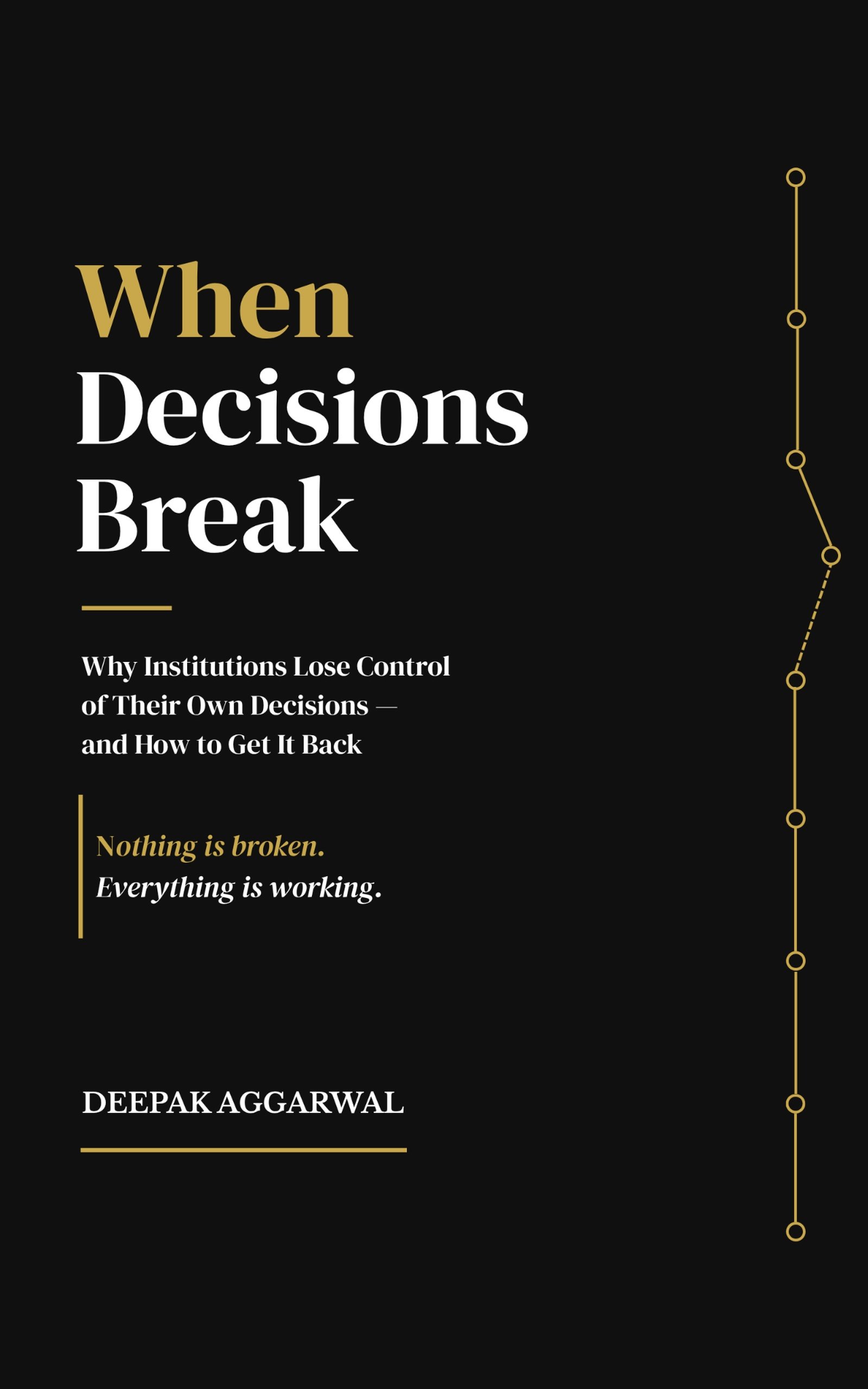
When Decisions Break
Why institutions lose control of their own decisions — and how to get it back.
When Decisions Break is a book about Decision Engineering™, institutional decision failure and the gap between what an organisation authorises and what it eventually executes.
Every part of the institution can explain what it did. The outcome is still different from what the institution intended. This book is about the distance between those two sentences.

all stores & formats
Published 31 July 2026 · 207 pages · Six movements, 27 chapters
Paperback ISBN 978-981-94-6739-6 · Ebook ISBN 978-981-94-6740-2
// About the book
Nothing appears to be broken. That is the problem.
Institutions rarely lose control of a decision through one visible failure. There is no alarm, no rogue actor and no obviously wrong model. Every team follows its process. Every control reports green. Yet somewhere between the mandate agreed in the boardroom and the action taken at the front line, the decision quietly becomes a different decision.
When Decisions Break follows two constructed cases — one financial, one clinical — from institutional purpose through policy, rules, judgment, execution and outcome. It shows how individually reasonable actions can combine into something no one authorised, and why conventional dashboards and audit trails often cannot reconstruct the complete decision after the event.
The book introduces the Decision Integrity Chain™: eight connected layers from Purpose to Feedback, with particular attention to the joins where intent, authority and accountability separate. It then develops four practical mechanisms for making consequential decisions visible, challengeable and replayable.
Written for boards, executives, risk and compliance leaders, technologists and regulators, it is a practitioner book rather than a technical manual. Its central question is simple: is the decision your institution is executing today still the decision it originally authorised?
The components are governed. The joins between them are not.
// How it is written
There is not a single equation in the book.
That was deliberate. A story can make an institutional failure visible in a way that a formula sometimes cannot. The argument is carried by narrative, from the boardroom to the front line and back to the board pack that was never built to answer the question being asked of it.
The formal treatment exists, but it lives elsewhere. Decision Velocity, the Fiduciary Gap™ and replay-ready infrastructure are developed in the eight research papers on SSRN. The book is the version a board can read on a flight.
A win on the dashboard. A loss on the balance sheet.
// The spine of the book
Eight layers, and the joins between them
The Decision Integrity Chain™ is the map the book builds towards. A decision travels through eight layers on its way from institutional purpose to execution and back. Control is usually lost not inside a layer but at the joins — where intent, authority and accountability begin to separate without anything going visibly wrong.
The book does not present the chain as a project plan. Real decisions loop back. An outcome exposes a rule that was wrong from the beginning; a judgment reveals that the original intent was never clear. Used properly, the chain does one thing: it locates the break.
// Contents
Six movements, twenty-seven chapters
Nothing Is Broken
1 Forty-Three Seconds · 2 The Model Was Not Wrong · 3 We Will Be in Touch · 4 The Dashboard Was Green
The Question Arrives Late
5 The Number That Was Eleven Points Off · 6 Six Teams, Twenty-One Days · 7 What the Logs Could Not Say · 8 The Question No One Could Answer · 9 The Evidence Was Always There
The Same Failure, Somewhere Else
10 Room Fourteen · 11 The Pathway Said Yes · 12 Optimised to Within an Inch · 13 Two Buildings, One Failure · 14 Five Sectors, One Failure
What Actually Broke
15 Everything Owned, Nothing Accountable · 16 The Chain That Wasn't There · 17 Governance Stopped at the Door · 18 The Chain Nobody Had Drawn · 19 Speed Hid Everything
The Cost of Not Knowing Why
20 The Question the Board Pack Was Never Built to Answer · 21 When Trust Runs Out · 22 The People the System Forgot · 23 Pay Now or Pay More Later
Designing Judgment Back In
24 What Gets Built in the Aftermath · 25 What the Chain Actually Looks Like · 26 The Speed That Hides Everything Twice · 27 The Next Decision
// Who it is for
Everyone accountable for the decision — and for the systems now making it
Each group sees a different part of the chain. The book is written so that they can read the same account of it.
The people who answer for a decision they did not personally make, increasingly through a board pack that was not designed to explain how it was reached.
Leaders who can evidence that every control operated, and still cannot evidence that the institution's intent survived the journey into execution.
The people building systems that now act with real authority — and who inherit the question of what those systems were permitted to decide.
It is also written for regulators, who are being asked to supervise decisions that no longer have a single human author, and for anyone who has sat in a review meeting where every account was accurate and none of them explained the outcome.
// Where it sits
One line of development, not separate projects
When Decisions Break sits at the centre of the Decision Engineering™ body of work at LumaThink: the research develops the formal argument, the book makes the pattern visible, and the Decision Drift Audit™ applies it to a live institutional decision.
The research
Eight peer-indexed papers on SSRN developing the Fiduciary Gap™, Decision Velocity and replayability as a governance standard.
Read the papers →When Decisions Break
The same argument, without equations, told as narrative rather than framework.
What Decision Engineering™ is →The Decision Drift Audit™
Ten days. Eight layers mapped, three exposure points identified, one board-ready finding.
Start the audit →// Common questions
Questions readers ask
What is When Decisions Break about?
It is about the gap between what an institution decides and what it actually does — how a decision changes shape as it travels into execution, and how the Decision Integrity Chain™ locates the join where control was lost. It also sets out four practical mechanisms for making consequential decisions visible, challengeable and replayable.
Is it a technical book or a business book?
Neither, and deliberately so. There is not a single equation in it. It is written as narrative, because a story can make an institutional failure visible in a way that a formula sometimes cannot. The formal treatment sits in the research papers instead.
Who should read it?
People who answer for institutional decisions and for the systems that now make them: board directors and non-executives, chief risk and compliance officers, executives accountable for automated processes, engineers building agentic systems, and regulators.
Are the case studies based on real institutions?
The two central cases are constructed — hypothetical composites built from documented failure patterns, not accounts of any specific institution or individual. Wider references to publicly documented failures are drawn from regulatory findings, official investigations, court records and other published primary sources.
How does the book relate to the research papers?
The eight SSRN papers carry the formal argument — the Fiduciary Gap™, Decision Velocity, replayability as a governance standard. The book carries the same argument without equations, so that it can be read by a board rather than a model risk team.
What formats is it available in?
Paperback and ebook. The ebook is on Kindle, Apple Books and Google Play; the full list of stores and formats is on Books2Read.
Start with one decision
Before you read it, a test worth applying to your own institution: name an important decision made in the last ninety days that your team could not fully replay today — the rule that applied, the data that was live, the authority that permitted it. If that decision comes to mind quickly, the book is about your institution.
If you have read it, a short review on Amazon or Goodreads helps other readers find it. Reactions and disagreements are welcome directly at deepak@lumathink.com.